

.svg)
.svg)
Running a charity event in 2026 means accepting one uncomfortable truth: most of your donors have already stopped carrying cash. The Reserve Bank of Australia puts cash at just 13 per cent of in-person payments, and for the average gala guest or community fun run participant, it's probably lower still. If your charity POS system can't meet people where they are—tapping a card or phone—you're leaving donations on the table.
But here's the catch. Most point-of-sale systems weren't designed for charities. They were built for retail and restaurants—monthly subscriptions, hardware that needs shipping, fee structures that assume daily transactions. None of that maps onto a charity that runs four events a year and needs 20 volunteers collecting simultaneously.
This guide breaks down what to actually look for in a charity POS system, compares the main options available in Australia and explains why mobile-first solutions are replacing traditional terminals at nonprofit events across the country.
Why Most POS Systems Fall Short at Charity Events
A POS system that works brilliantly in a café can be completely wrong for a fundraising gala. The operational realities are different in almost every way.
Charities don't process transactions every day. Many run events seasonally—a handful of big nights or community days spread across the year. Paying monthly software fees between those events is money going straight out of the donation pool. And if each terminal costs $200 to $400 in hardware, equipping ten volunteers for a walkathon suddenly becomes a budget line item on its own.
Then there's the logistics. Traditional terminals need to be ordered weeks in advance, charged, connected to Wi-Fi or cellular, assigned to specific people, collected at the end of the night and returned. For volunteer-run organisations, that overhead eats into the funds you're trying to raise.
Charity events also have a unique pattern: short bursts of high-volume, low-value transactions. A donor tapping $20 at a sausage sizzle. A table of guests scanning a QR code between courses at a gala dinner. A parent dropping $10 at a school fun run. You need a system that handles that volume quickly, across multiple collection points, without bottlenecks.
What to Look for in a Charity POS System
Not every feature on a POS comparison chart matters for nonprofits. Here's what actually moves the needle for charity event fundraising.
No monthly fees. If your charity runs events quarterly or seasonally, you shouldn't be paying for a POS system during the months it's sitting idle. Transaction-only pricing—where you only pay when donations come in—keeps costs directly proportional to revenue.
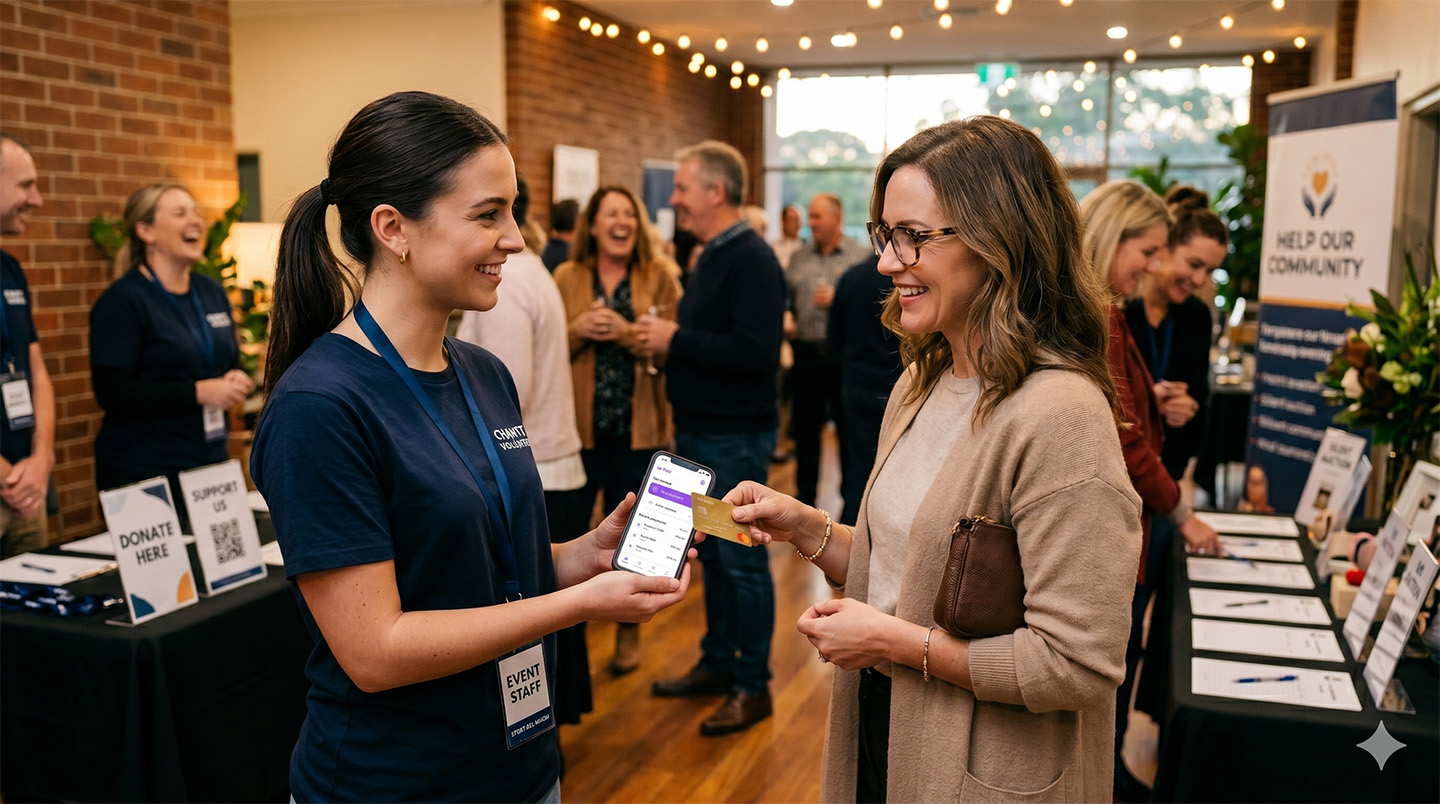
No hardware to buy or rent. The best charity POS systems in 2026 run on the smartphones your volunteers already carry. No charity payment terminal to order, charge, ship back or worry about losing at a crowded outdoor event.
Unlimited team members. Volunteer numbers fluctuate wildly between events. A platform that charges per user penalises you for scaling up. Look for unlimited users with role-based permissions so volunteers can process donations without accessing bank details or sensitive settings.
Multiple payment methods. Tap to pay covers in-person moments, but you also want QR codes for signage and table displays, payment links for pre-event email campaigns and PayID for larger corporate donations. The more ways donors can give, the more they will.
Real-time reporting. Knowing your running total during an event lets you adjust on the fly—redeploy volunteers to busier areas, add signage where foot traffic is high, or announce a milestone from the stage to encourage more giving.
Fast settlement. Charities need funds quickly, not tied up for a week. Card payments settling within one to two business days and PayID settling instantly should be the baseline.
Comparing the Options: POS for Nonprofits in Australia
The Australian market has several POS providers, but their suitability for charity events varies widely. Here's how the main contenders stack up.
Square
Square is one of the most recognisable names in payments, and it does offer a nonprofit solution. There are no monthly software fees on the basic plan, and it supports contactless payments, inventory tracking and real-time reporting. The catch for charities is the transaction rate: 1.6 per cent per tap in Australia, which is higher than some alternatives. And whilst the software is free, you'll need Square hardware (Reader, Terminal or Stand) to accept in-person payments—each device is an additional cost, and you need one per collection point. For a charity with 15 volunteers spread across an event, that adds up fast.
Zeller
Zeller has made a name for itself with transparent pricing: 1.4 per cent per tap with no monthly fees. The Zeller Terminal 2 costs $199 outright, which is fair for a permanent business but still represents a capital outlay for charities. To their credit, Zeller offers cashback on transaction fees for the first $3,000 of donations accepted by registered not-for-profits—a nice touch. But like Square, you need a physical charity payment terminal at each collection point. If your event has roaming volunteers or multiple donation stations, you're buying multiple devices.
Zeffy
Zeffy positions itself as 100 per cent free for nonprofits, which sounds ideal on paper. Their model works by prompting donors to leave an optional tip to cover platform costs. It's a strong option for online donation pages and ticketing, but their in-person POS capability at Australian events is limited compared to dedicated mobile payment platforms. If your primary need is on-the-ground collection at a physical event, Zeffy alone may not cover it.
Epos Now
Epos Now targets retail and hospitality with inventory management and staff scheduling. Good for charity shops with a permanent counter, but overbuilt for event-based fundraising.
Pebl
Pebl was built differently. It turns any compatible iPhone or Android into a contactless payment terminal—no hardware to buy, no terminals to rent. The transaction rate is 1.8 per cent per card payment (or $1.50 per PayID transaction), with no monthly fees, no setup costs and no lock-in contracts. Every volunteer downloads the app and joins your charity's team, so you can scale from five collectors to 50 without additional cost.
Where Pebl stands apart for charities is the combination of payment methods: Tap to Pay on both iPhone and Android, QR codes for signage and table displays, shareable payment links for pre-event campaigns and PayID for instant bank transfers. Role-based permissions mean volunteers can only process donations—they can't access bank details or refund transactions. And real-time reporting gives event organisers a live view of donation totals as they come in. You can explore the full feature set for charities here.
What the 2026 Surcharge Ban Means for Charity Payments
From 1 October 2026, Australian businesses will no longer be allowed to pass card surcharges on to customers. The Reserve Bank of Australia's Payments System Board estimates this will save consumers roughly $1.6 billion per year across the economy.
For charities, the impact is worth understanding. If you've been using automatic surcharging to offset transaction fees on donations—a feature offered by Pebl, Square and Zeller—that option will disappear. Transaction fees will need to be absorbed into your operating costs rather than passed to donors.
This makes the transaction rate itself even more important when choosing a POS system. The difference between 1.4 per cent and 2.6 per cent on $50,000 worth of donations is $600—real money for a charity. But it also makes the total cost of ownership matter more than ever. A platform with a slightly higher transaction rate but no hardware costs, no monthly fees and no per-user charges can still come out ahead of a cheaper-per-transaction alternative that requires you to buy five terminals.
What Happens When Charities Ditch the Terminal
The comparison above is useful in theory. But the real test is what happens when charities actually switch from traditional charity payment terminals to mobile POS.
When Epilepsy Action Australia moved from hired EFTPOS terminals to QR code donations at their Purple for Purpose Gala, they didn't just save on hardware costs. They raised over 200 per cent more than the previous year. The difference wasn't the technology alone—it was the removal of friction. Guests donated between courses by scanning a code on the table, rather than queuing at a terminal station. More touchpoints, less waiting, more donations.
Head Above Water's annual 24-hour Swimathon at Collaroy Rockpool tells a similar story from a different angle. Their event runs across multiple zones—a BBQ, a registration desk, the pool area—for 24 hours straight. Staffing those zones with rented terminals would have meant six or more devices at $200–$400 each, plus logistics. Instead, volunteers used tap to pay on their own phones. The event has raised over $880,000 across six swimathons, and the charity's hardware cost per event is zero.
Ronald McDonald House Sydney runs fundraising events year-round—community days, corporate partnerships, awareness campaigns. A hardware-based POS would mean ordering and returning terminals for each one. With a mobile-first setup, the same team uses the same app every time. No per-event logistics.
For a step-by-step walkthrough of how to equip volunteers to accept donations without any hardware, we've written a practical guide.
Already Exploring Alternatives to Shout for Good?
If your charity has been using Shout for Good (ANZ's charity payment platform), you may already be looking at your options. Pebl offers the same core functionality—mobile donations, Apple Pay integration and event-based payment tools—with extras that Shout didn't provide, including Tap to Pay on Android, PayID for instant bank transfers and unlimited team member access. There’s no complex migration process: set up your charity account and you’re operational in under 10 minutes. For a full comparison, see our guide to Shout for Good alternatives.
How to Choose the Right POS for Your Next Charity Event
The right choice depends on how your charity actually operates. Ask yourself three questions.
How many collection points do you need? If the answer is more than two or three, hardware-based systems become expensive quickly. A mobile solution that runs on volunteers' phones scales without additional cost.
How often do you run events? Monthly fees punish seasonal fundraisers. Transaction-only pricing means you pay nothing between events.
Do you need in-person and online collection? If you want to capture donations before, during and after an event—through tap to pay at the venue, QR codes on printed materials and payment links in email campaigns—choose a platform that handles all three in one place.
For most Australian charities running event-based fundraising in 2026, a mobile-first POS system with no hardware costs and unlimited volunteers is the strongest combination of flexibility and value. Visit the Pebl charity page to see how it works in practice, or book a demo to get your team set up and collecting in under 10 minutes.
Frequently Asked Questions
What is a charity POS system?
A charity POS system is a point-of-sale solution that allows nonprofits to accept donations and payments at events and in-person fundraising activities. Unlike retail POS systems, the best charity POS solutions are designed for short-burst, high-volume donation collection with minimal hardware and easy volunteer onboarding.
Do I need a physical terminal to accept card donations at events?
Not any more. You don't need a physical charity payment terminal to accept card donations. Mobile POS solutions like Pebl turn any compatible iPhone (XS or later, iOS 18+) or Android device (NFC-enabled, Android 13+) into a contactless payment terminal. Donors tap their card, phone or watch against the volunteer's device and the donation is processed in seconds.
How much does a POS system cost for a nonprofit?
Costs vary widely. Hardware-based systems like Zeller charge $199 per terminal plus 1.4 per cent per transaction. Square charges 1.6 per cent per tap but requires hardware purchases. Pebl charges 1.8 per cent per card payment (or $1.50 per PayID transaction) with no hardware, no monthly fees and no setup costs—making it the most cost-effective option for events with multiple volunteer collection points.
Can I accept donations online and in person with the same system?
Yes. Platforms like Pebl offer tap to pay for in-person collection, QR codes for signage and printed materials, and shareable payment links for email, SMS and social media campaigns. This means you can capture donations before, during and after your event from a single platform.
Will the 2026 surcharge ban affect charity donations?
From 1 October 2026, businesses and charities in Australia will no longer be able to pass card transaction fees on to customers or donors via surcharging. This means charities will need to absorb transaction fees as an operating cost, making the total cost of your POS system—including hardware, monthly fees and per-transaction rates—more important than ever when choosing a platform.
Is Pebl secure enough for processing charity donations?
Pebl is PCI DSS Level 1 compliant—the highest level of payment security certification. No card data is stored on the volunteer's device, and role-based permissions ensure volunteers can only process payments. They can't access bank details, issue refunds or change business settings unless you grant those permissions specifically.
How quickly do charity donations settle into our bank account?
Card payments typically settle within one to two business days into your nominated Australian bank account. PayID transactions settle instantly. This means your charity can access donated funds within days of an event, not weeks.