

.svg)
.svg)
When you run one location, payments are simple. Pick a provider, set up a terminal, done. But when you're managing 10 locations—or 500, or 5,000—payments become one of the messiest operational problems a franchise network can face.
Different franchisees sign up with different providers. Some are on Zeller, some on Square, a few still renting EFTPOS terminals from their bank. Transaction rates vary. Reporting formats don't match. Head office can't see a consolidated view of what's happening across the network without chasing spreadsheets from individual operators. And when a franchisor wants to roll out a new payment method—like QR codes or PayID—the fragmentation makes it close to impossible.
This is the franchise payment system problem that nobody talks about until it costs real money. Mobile payments for franchise networks aren't just a convenience upgrade—they're an operational necessity. And in 2026, with contactless payments now accounting for the vast majority of Australian transactions, the cost of getting it wrong is growing.
The Hidden Cost of Fragmented Payments Across Franchise Locations
Payment fragmentation in franchise networks isn't just an inconvenience. It creates real, measurable problems that compound as you scale.
Inconsistent customer experience. A customer visiting one Jim’s Cleaning franchisee might tap their phone to pay. At another location, the operator only accepts bank transfers or cash. The brand promise says one thing; the payment experience says another. In 2026, when digital wallets account for more than 500 million monthly transactions in Australia, an inconsistent payment experience is a customer experience failure.
No network-wide visibility. If each franchisee uses a different payment provider, head office has no single dashboard showing transaction volumes, average values or seasonal trends across locations. That data gap makes it harder to spot underperforming locations, forecast revenue or negotiate better rates based on aggregate volume.
Compliance risk. Payment security standards like PCI DSS apply to every entity that processes card data. When franchisees choose their own providers, the franchisor has limited visibility into whether each location is actually meeting compliance requirements. One franchisee using an outdated or non-compliant system creates risk for the entire brand.
Onboarding friction. Every new franchisee needs a payment setup. If there's no standard system, each one goes through their own provider selection, application, hardware ordering and integration process. That slows down the time from signing a franchise agreement to taking the first payment—and it means new operators start with a different setup than the rest of the network.
What a Standardised Franchise Payment System Actually Looks Like
Standardisation doesn't mean forcing every franchisee onto an expensive, inflexible enterprise platform. It means choosing a single payment system that works for every location type in your network—from a mobile operator working out of a van to a fixed storefront—and rolling it out consistently.
The right franchise payment system should handle three things well.
Centralised Team Management
Head office or the network administrator should be able to add new franchisees, assign them to teams and set role-based permissions from a single dashboard. When a franchisee leaves the network, access is revoked centrally. When a new one joins, they're onboarded in minutes, not weeks.
This is where unlimited team members becomes a critical feature. A franchise network with 200 operators shouldn't be paying per-user fees that scale linearly with growth. The payment platform cost should be proportional to transaction volume, not headcount.
Consistent Payment Acceptance
Every location in the network should accept the same payment methods. In 2026, that means contactless card payments (Visa, Mastercard, AMEX), digital wallets (Apple Pay, Google Pay), QR codes and PayID at minimum. If a customer can tap to pay at one franchise location, they should be able to tap to pay at every location.
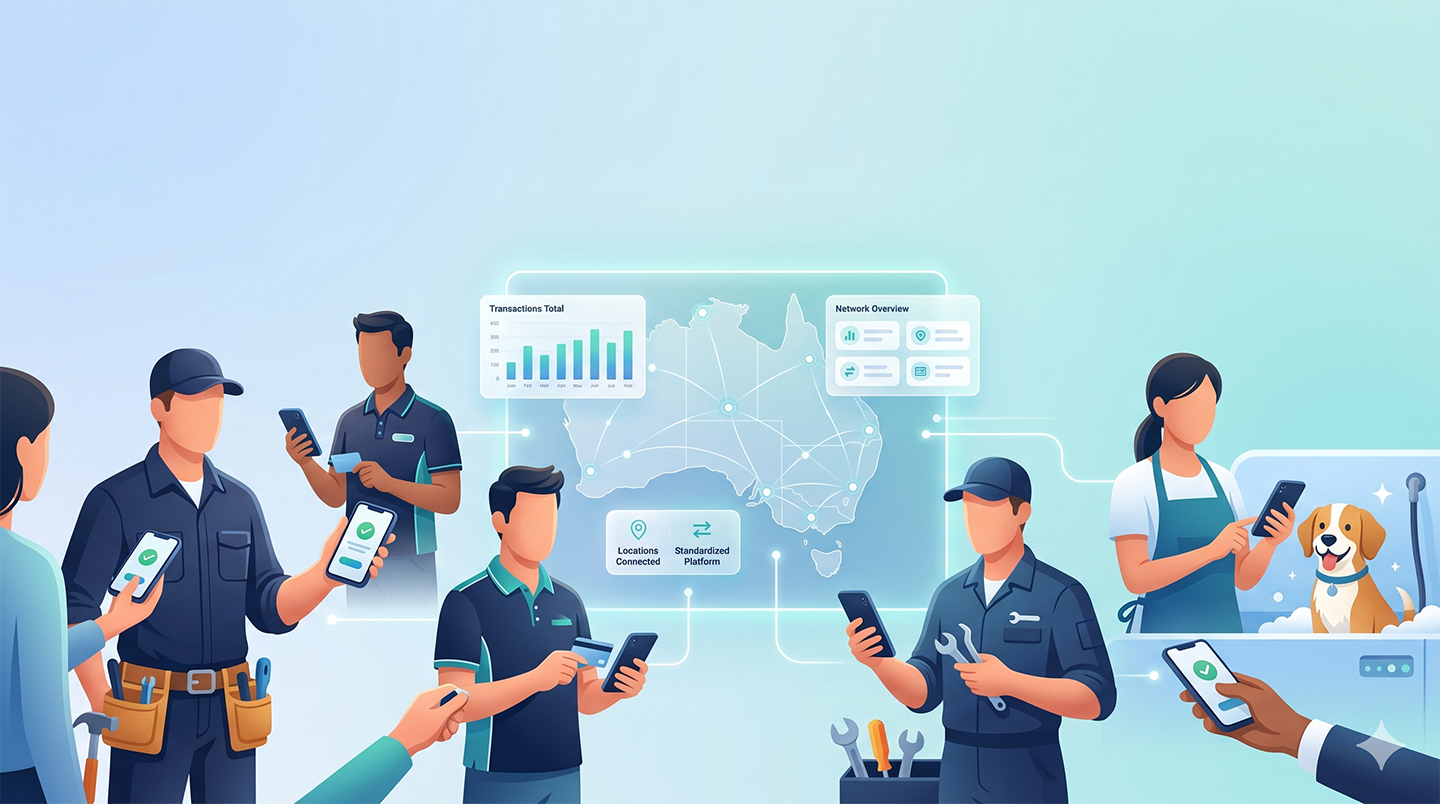
Mobile-first platforms have a natural advantage here. Instead of shipping hardware to every new location, each franchisee uses the phone they already carry. A plumber can accept payment on the driveway. A cleaner can process a transaction at the front door. A mobile dog washer can take payment at the park. No terminal required.
Network-Wide Reporting and Visibility
The franchisor needs to see what's happening across the entire network in real time: total transaction volume, average transaction value by location, payment method breakdowns and settlement status. Individual franchisees should see their own data, whilst head office sees the aggregate. This kind of visibility turns payment data into a management tool—spotting growth trends, identifying locations that are struggling and making informed decisions about where to invest.
How Australia's Largest Franchise Network Approached Mobile Payments
Jim's Group is the largest franchise family in Australia, with more than 5,000 franchisees across 52 divisions. From Jim's Cleaning to Jim's Plumbing, Jim's Fencing to Jim's Dog Wash—the network spans dozens of service categories, each with operators working in the field rather than behind a counter.
That operational reality makes traditional POS systems impractical. A Jim's franchisee doesn't have a shopfront with a countertop terminal. They're at a customer's home, in a van, at a job site. They need to accept payment wherever the work happens, on the device they already have in their pocket.
Jim's Group integrated Pebl via enterprise API, giving franchisees across the network a consistent way to accept contactless payments on their personal smartphones. The setup requires no additional hardware. A new franchisee downloads the Pebl app, is added to the Jim's Group team and can accept contactless card payments on their own phone immediately. That's it.
For a network the size of Jim's Group, this kind of standardisation means every customer interaction ends with the same payment experience, regardless of which division or operator they're dealing with. The centralised dashboard gives network administrators visibility across the entire franchise—the same kind of real-time reporting that charities and event organisations are already using to track donations across multiple volunteer teams.
Why Mobile-First Beats Terminal-Based for Franchise Networks
Traditional POS terminals were designed for fixed locations. Franchise networks—especially service-based ones—need something different.
No hardware logistics. Shipping terminals to new franchisees, replacing broken devices, managing firmware updates across hundreds of machines—that's a support burden. When the POS system runs on the franchisee's own phone, the hardware problem disappears entirely.
Instant onboarding. A new franchisee can download an app and start accepting payments in under 10 minutes. Compare that to the 10 business days (or more) it typically takes to receive a terminal, set up a merchant account and run test transactions.
Lower total cost. No terminal purchases ($199–$400 per device), no monthly rental fees, no hardware insurance. The franchise pays a flat transaction rate with no fixed costs. For a network rolling out to hundreds of locations, the saving over hardware-based alternatives is substantial.
Flexibility across division types. A franchise network often includes a mix of mobile operators, home-based services and physical locations. A mobile-first payment platform works for all of them. The plumber on a job site uses the same system as the pet groomer in a shopfront. Same app, same reporting, same experience.
What the Surcharge Ban Means for Franchise Payment Strategy
Australia's card surcharge ban takes effect on 1 October 2026. After that date, franchisees will no longer be able to pass card processing fees on to customers. Every transaction fee becomes an operating cost that the franchisee absorbs.
For franchise networks, this adds urgency to the standardisation question. If each franchisee is on a different provider with a different rate, the surcharge ban hits some harder than others. A franchisee on 2.6 per cent per transaction absorbs twice the cost of one on 1.4 per cent. That inconsistency creates inequity within the network and makes it harder for head office to forecast and manage costs.
A single, standardised payment platform gives the franchisor two advantages: a consistent, known transaction rate across all locations, and the ability to negotiate that rate based on aggregate network volume rather than individual franchisee throughput. The bigger the network, the stronger the negotiating position.
Getting Started: Rolling Out Standardised Payments Across Your Franchise
If your franchise network is still running fragmented payment setups, the transition to a standardised platform is simpler than you might expect. Here's a practical approach.
Audit your current state. Survey your franchisees to map which providers they're using, what rates they're paying and what payment methods they can accept. This gives you a baseline for the business case.
Define your requirements. At minimum, you need: unlimited team members (no per-user fees at scale), role-based permissions (franchisees can process payments but not access network-level data), centralised reporting (head office sees everything), support for contactless cards, digital wallets and QR codes, PCI DSS compliance and an API for enterprise integration.
Run a pilot. Roll out to a handful of locations first. Measure franchisee onboarding time, customer satisfaction with the payment experience and the reporting data you get back. Then expand.
Standardise network-wide. Once the pilot confirms the platform works, set it as the network standard. New franchisees onboard onto it from day one. Existing franchisees transition as their current provider contracts expire.
Pebl's enterprise API and unlimited team member model were designed for exactly this kind of rollout. No hardware to ship, no per-user costs to manage, and every franchisee is accepting payments within minutes of joining the network.
And because the same platform handles both commercial payments and donations, franchise networks that run community or charity events get an added benefit: franchisees can accept donations at events using the same app they use for daily payments, with no separate setup. To discuss enterprise integration for your franchise network, book a demo or visitpeblpay.com.au.
Frequently Asked Questions
What is a franchise payment system?
A franchise payment system is a standardised platform that allows every location in a franchise network to accept payments using the same tools, the same rates and the same reporting structure. It replaces the patchwork of individual provider relationships that many franchise networks default into, giving head office visibility and franchisees consistency.
Can a mobile payment app replace EFTPOS terminals across a franchise network?
Yes. Mobile-first platforms like Pebl turn any compatible iPhone or Android into a contactless payment terminal. For service-based franchises where operators work in the field—plumbers, cleaners, dog walkers, mobile mechanics—a phone-based solution is more practical than shipping terminals to every location. It also removes the hardware cost and logistics burden from the network.
How do role-based permissions work in a franchise context?
Role-based permissions let the network administrator control what each franchisee or team member can see and do. A franchisee might be able to process payments and view their own transaction history, but not access other locations' data, issue refunds beyond a certain amount or change network-level settings. This protects both the brand and individual operators.
How long does it take to onboard a new franchisee onto a standardised payment platform?
With a mobile-first platform, onboarding takes under 10 minutes. The new franchisee downloads the app, is added to the franchise team by the network administrator and can start accepting payments immediately. Compare this to hardware-based setups that can take 10 or more business days for terminal delivery, merchant ID provisioning and testing.
What payment methods should a franchise network support in 2026?
At minimum: contactless cards (Visa, Mastercard, AMEX), digital wallets (Apple Pay, Google Pay), QR codes and PayID. Digital wallets alone account for over 500 million transactions per month in Australia, so any franchise payment system that doesn't support them is leaving revenue on the table.
How does the 2026 surcharge ban affect franchise networks?
From 1 October 2026, franchisees will no longer be able to pass card processing fees to customers via surcharging. This makes transaction rates a direct operating cost. A standardised franchise payment system ensures every location pays the same rate, and the franchisor can negotiate based on total network volume to get the best possible pricing.
Does Pebl offer enterprise integration for franchise networks?
Yes. Pebl offers enterprise API integration for franchise and fleet networks. Jim’s Group, Australia’s largest franchise family with 5,000+ franchisees, uses Pebl’s enterprise integration to standardise mobile payments across their network. The API allows for centralised onboarding, reporting and management at scale. Franchise networks that also run charity fundraising events can use the same platform for accepting donations at community events—and those exploringalternative platforms for nonprofit fundraising.