

.svg)
.svg)
Cash is disappearing from Australian wallets. According to the Reserve Bank of Australia, cash now accounts for just 13 per cent of in-person payments—down from 70 per cent a decade ago. For charities that rely on in-person fundraising, that shift isn’t just a trend. It’s a problem that’s costing you donations every single event.
The good news? Going cashless doesn’t require expensive EFTPOS terminals or complicated payment infrastructure. With the right approach, your charity can accept donations through contactless card taps, QR codes, digital wallets and payment links—all from a smartphone.
This guide covers everything you need to plan, launch and run cashless fundraising at your next event. We’ll walk through the available payment methods, how to choose the right setup for your organisation and what Australian charities are already doing to raise more with less friction.
Why Cashless Fundraising Matters More Than Ever
The trend isn’t slowing down, either. Industry reports put cash at roughly 14 per cent of Australian point-of-sale transactions in 2024, and that number keeps falling year on year. When your donors aren’t carrying cash to the supermarket, they certainly won’t have it at your gala dinner or community fun run.
There’s a compounding problem, too. The donor pool in Australia is shrinking. Fewer people are giving than five years ago, and charities can’t afford to lose willing donors simply because the payment method isn’t convenient enough. If someone’s ready to give but you can only take cash, that’s a donation you’ll never see.
Cashless fundraising solves both problems at once. It meets donors where they already are—paying with their phone or card—and removes the friction that kills spontaneous giving. No fumbling for coins, no “sorry I don’t have cash,” no walking past the donation bucket with good intentions and an empty wallet.
The Four Pillars of Cashless Fundraising
There are four main ways to accept cashless donations at events and campaigns. The strongest fundraising strategy uses a combination of all four, giving every donor a way to contribute that feels natural to them.
1. Tap to Pay (Contactless Card and Digital Wallet Donations)
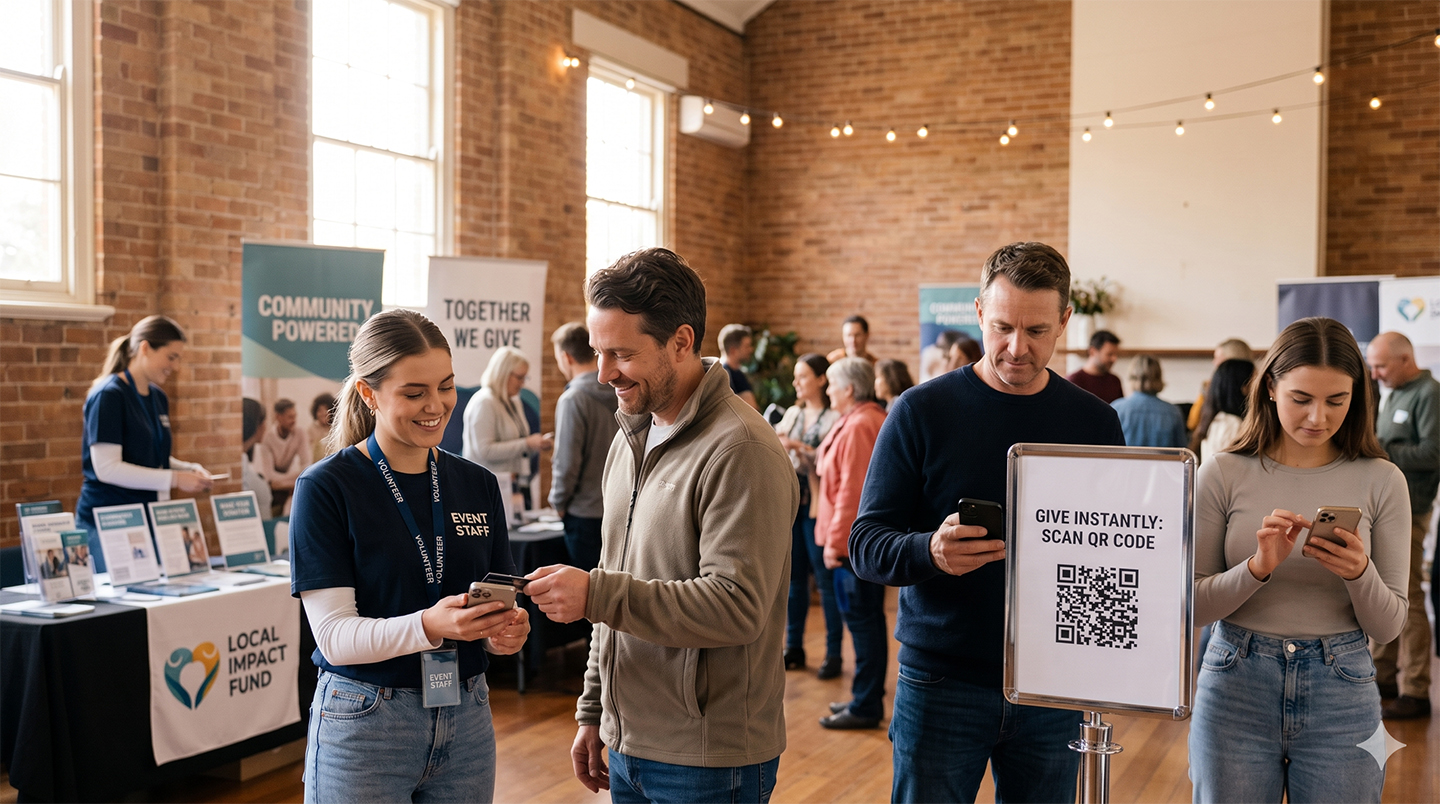
This is the closest digital equivalent to dropping cash in a tin. A volunteer holds out their smartphone, the donor taps their card, phone or watch, and the donation goes through in seconds. It works with Visa, Mastercard, AMEX, Apple Pay and Google Pay.
Tap to pay is ideal for high-traffic moments—roaming collectors at a walkathon, registration desks at a gala or volunteers working a sausage sizzle. For a detailed walkthrough of setting up tap to donate at your next event, we’ve put together a step-by-step guide.
2. QR Code Donations
QR codes work differently from tap to pay. Instead of needing a volunteer at every donation point, you print a code on signage, table cards, posters or event programmes. Donors scan with their phone camera and complete the donation in their browser. No app required on the donor’s side.
This method shines at seated events like gala dinners (where guests can donate between courses), outdoor festivals (signage at multiple touchpoints) and ongoing campaigns where physical presence isn’t always possible. You can set a fixed amount or leave it open for the donor to choose.
3. Payment Links
Payment links extend your fundraising beyond the event itself. Generate a shareable link and distribute it via email newsletters, SMS, social media posts or event invitations. Donors click, choose an amount and pay—no app, no account, no friction.
This is where cashless fundraising really outperforms traditional methods. An EFTPOS terminal only works at the event. A payment link works before, during and after, capturing donations from supporters who can’t attend in person or who want to contribute from the comfort of their couch.
4. PayID (Instant Bank Transfers)
PayID lets donors transfer money directly from their bank account using a registered email or phone number. The transfer is instant and settlement is immediate. For larger donations or corporate pledges where card transaction fees matter, PayID offers a lower-cost alternative.
Planning Your Cashless Fundraising Strategy
Going cashless isn’t just a technology decision. It’s an event planning decision. Here’s how to think through the setup for your specific situation.
Match the Method to the Moment
Consider how donors will interact with your event and choose your primary and secondary collection methods accordingly:
- High-traffic, fast-moving events (fun runs, markets, door knocks): Tap to pay as primary, QR codes as backup at stations
- Seated or stationary events (gala dinners, conferences, awards nights): QR codes on tables as primary, tap to pay for bar or auction areas
- Online or hybrid campaigns (email appeals, social media drives): Payment links as primary, QR codes in any physical materials
- Large-scale public events (expos, festivals, community days): All four methods working together
Brief Your Volunteers
Your cashless system is only as good as the people using it. Volunteers don’t need to be tech-savvy, but they do need a quick briefing on which payment methods to offer, how to process a tap to pay donation and where QR code signage is placed.
A five-minute walkthrough before the event is usually enough. The simpler your setup, the less training required. If a volunteer doesn’t want to install an app on their personal phone, they can still direct donors to QR code stations or share a payment link.
Set Up Quick-Select Donation Amounts
Pre-configured amounts like $10, $20 and $50 speed up the process and gently anchor donors toward higher contributions. You can still offer a custom amount option for those who want to give a different figure, but having defaults reduces decision fatigue and keeps queues moving.
What to Look for in a Cashless Fundraising Platform
Not all payment platforms are built for charities. Here’s what to prioritise when evaluating your options.
No hardware required. If a platform needs you to buy or rent a terminal, you’re back to the same EFTPOS problem. Look for solutions that work on the smartphones your team already owns.
No monthly fees or lock-in contracts. Many charities run events seasonally. Whilst paying monthly fees during quiet periods eats into funds raised at your last event, transaction-only pricing means you only pay when you’re actively collecting.
Unlimited team members. If a platform charges per user, costs escalate quickly for volunteer-heavy events. Your 50 volunteers at a walkathon shouldn’t cost more than your 5-person office team.
Role-based permissions. Volunteers should be able to process donations without accessing your bank details, issuing refunds or changing business settings. Good platforms let you control exactly what each team member can see and do.
Real-time reporting. Seeing donation totals as they come in helps you adjust your strategy mid-event. If one area of the venue is underperforming, you can redeploy volunteers or add signage. Post-event, you need exportable transaction data for reconciliation and reporting.
Tax-deductible receipting. For DGR-registered charities, automatic digital receipts save hours of admin and give donors the documentation they need for tax time.
Pebl ticks every one of these boxes. It charges a flat 1.8 per cent per card transaction with no setup fees, no monthly charges and no lock-in. Every volunteer can accept donations on their own phone, with role-based permissions keeping sensitive data secure. You can explore the full feature set for charities here.
Real Results: How Australian Charities Are Fundraising Cashless
This isn’t theoretical. Australian charities are already using cashless fundraising to raise more with less overhead.
Epilepsy Action Australia used QR code donations at their Purple for Purpose Gala, placing codes on table signage and donation cards. Guests scanned and donated between courses. The result? Over 200 per cent more raised compared to the previous year, when they’d used hired EFTPOS terminals.
Head Above Water, a Northern Beaches charity focused on mental fitness, equipped volunteers at their annual 24-hour Swimathon with tap to pay on their personal phones. Collectors at the BBQ, registration desk and around the pool could accept donations instantly, without a single EFTPOS machine. The event has raised over $880,000 across six swimathons.
Ronald McDonald House Sydney uses mobile donations across multiple fundraising events throughout the year, giving their volunteer teams the flexibility to collect at community days, corporate partnerships and awareness campaigns without the logistical headache of managing hardware.
If You’re Moving Away from Shout for Good
If your charity has been using Shout for Good (ANZ’s charity payment platform), you may already be exploring alternative charity fundraising platforms. Pebl offers the same core functionality—mobile donations, Apple Pay integration and event-based payment tools—with some extras that Shout didn’t provide, including Tap to Pay on Android, PayID for instant bank transfers and unlimited team member access.
There’s no complex migration process. Set up your charity account and you’re operational in under 10 minutes.
Getting Started: Your Cashless Fundraising Checklist
Ready to go cashless at your next event? Here’s a quick checklist to get you from zero to collecting in under 10 minutes.
- Choose your platform and sign up with your charity’s ABN, bank details and a nominated administrator
- Add your volunteer team and set appropriate permissions for each role
- Create donation products with quick-select amounts ($10, $20, $50) and a custom option
- Generate QR codes and send them to your printer for signage, table cards and posters
- Create payment links for pre-event email campaigns and social media promotion
- Brief your volunteers with a five-minute walkthrough on event day
- Test a transaction before doors open to confirm everything’s working
Visit the Pebl charity page to learn more about how Pebl works for charities and events, or book a demo to get started.
Frequently Asked Questions
What does cashless fundraising actually mean?
Cashless fundraising means accepting donations through digital payment methods instead of physical cash. This includes contactless card taps (Visa, Mastercard, AMEX), digital wallets (Apple Pay, Google Pay), QR code payments, online payment links and bank transfers via PayID.
Do donors need to download an app to donate?
No. For tap to pay, donors simply tap their card or phone against the volunteer’s device. For QR code donations, they scan the code and pay through their phone’s browser. No app download is required on the donor’s side.
How much does it cost to go cashless?
It depends on the platform. Some charge monthly fees, hardware rental and per-transaction rates. Pebl charges a flat 1.8 per cent per card transaction (or $1.50 per PayID transaction) with no monthly fees, no setup costs and no lock-in contracts. You can also enable automatic surcharging to pass the fee to the donor, meaning your charity pays nothing in processing costs. Keep in mind that from 1 October 2026, new RBA rules will prohibit surcharging—after that date, transaction fees become an operating cost your charity absorbs directly.
Is cashless fundraising secure?
Yes, provided you use a PCI DSS compliant platform. Pebl is PCI DSS Level 1 compliant and uses end-to-end encrypted payment technology. No card data is stored on the volunteer’s device, and role-based permissions ensure volunteers can only process payments—they can’t access bank details or sensitive business information.
What if some donors still want to pay with cash?
Going cashless doesn’t mean refusing cash. You can still have a cash tin available. The goal is to add digital payment options so that the majority of donors—who aren’t carrying cash—can still contribute. In practice, most charities find that once they offer tap to pay and QR codes, digital donations far outstrip what the cash tin collects.
Can we use cashless fundraising for online campaigns too?
Absolutely. Payment links can be shared via email, SMS and social media, making them perfect for online donation drives, peer-to-peer fundraising and pre-event promotion. QR codes can also be included in digital communications for donors who prefer that method.
How quickly do we receive the funds?
Card payments typically settle into your nominated Australian bank account within 1–2 business days. PayID transactions settle instantly.