



.svg)
.svg)
Australian charities are raising money in a tougher room than they were a few years ago. The ACNC's most recent Australian Charities Report shows donations and bequests fell to $14.8 billion even as demand for services keeps climbing. When giving tightens, the fundraising gala, the charity auction and the trivia night carry more weight than ever — one well-run night can fund a program for months. Which makes it worth asking the question most committees skip until the doors open: how, exactly, is the money going to change hands on the night?
Cash used to answer that question. It no longer does. The RBA's 2025 Consumer Payments Survey found cards are now the default even for small purchases, with cash steady at around 15% of payments. Your guests will arrive expecting to tap, and the events that raise the most are the ones ready to take the money the second someone decides to give it.
A fundraising night is really four payment moments
It helps to stop thinking of "the event" as one payment problem and break it into the four distinct moments where money actually moves:
- Entry and tickets — walk-ups at the door, upgrades, table top-ups.
- The silent auction — dozens of small-to-mid bids that all need settling before people leave.
- The live auction and paddle raise — a handful of large, high-emotion wins and pledges.
- Raffles and side stalls — fast, low-value, high-volume sales scattered around the room.
Each moment has a different rhythm, and the classic mistake is funnelling all four through a single card reader at one checkout table. That's how you end up with a queue at 10pm and generous guests drifting to the car park with their wallets still full.
Equip the whole room, not one checkout table
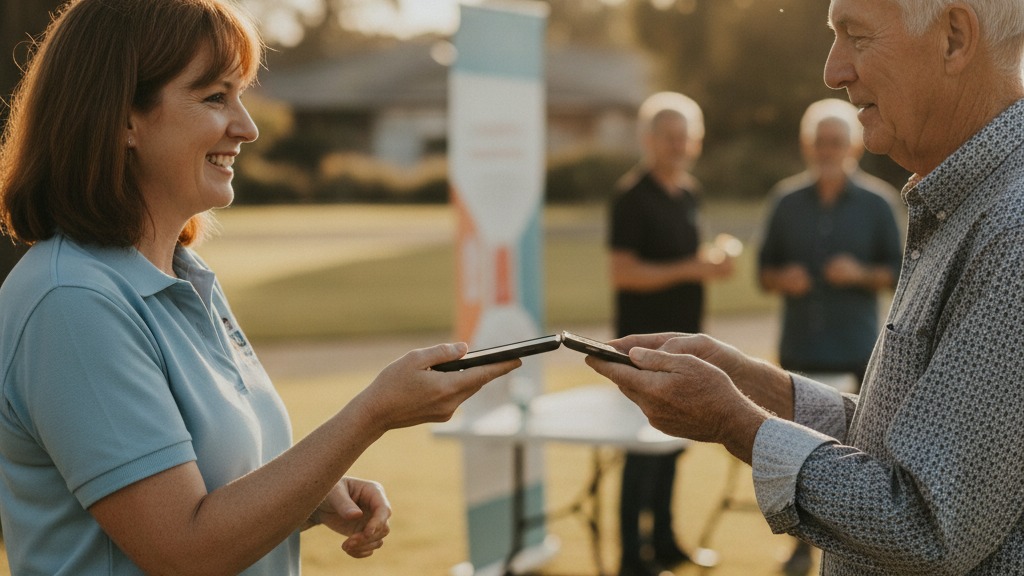
The most reliable fix is to turn every volunteer's phone into a payment terminal. Pebl runs Tap to Pay on iPhone and Android, so the person taking silent-auction settlements, the two people working the raffle table and the MC's runner can all accept a contactless card or mobile wallet on the device already in their pocket — no rented hardware, no docket to lose. Because Pebl for Teams adds unlimited team members under one account at no extra cost, scaling from three phones to fifteen for one busy night doesn't change what you pay.
This is where it pays to think of payments as infrastructure rather than a gadget. Pebl came into software from the payments side, which is why the whole team runs on one account with tailored permissions and one live view of the night. If you're weighing up what to put in volunteers' hands, our guide to the best POS systems for charities and nonprofit events in 2026 walks through the options in more detail.
Big auction wins: where PayID earns its keep
The live auction is where the payment method genuinely affects how much reaches your cause. A winning bid of $6,000 on a card carries card interchange like any other card transaction — and from 1 October 2026, when the RBA's surcharge ban takes effect, you can no longer pass that cost to the winner, so it comes straight out of the donation.
PayID is the exception worth knowing. It runs on the New Payments Platform as a real-time, account-to-account transfer, so it sits outside the card rails entirely and carries no card interchange fee. For a large auction win or a five-figure pledge, asking the winner to send a PayID transfer can mean the full amount lands with the charity instead of a card-fee slice being shaved off the top. It settles fast, too, so you can confirm the payment before the winner has left their seat.
QR codes and payment links: brilliant tools, not fee-dodgers
QR codes and payment links are perfect for a fundraising night — a QR on every table for the silent auction, a payment link texted to the guest who wants to settle a raffle win from their phone. Just be clear about what they are: both are card-based transactions under the hood, so interchange still applies exactly as it would for a tap. Use them because they're fast and let people pay from where they're sitting, not because they avoid card costs — they don't. PayID is the only method on the night that genuinely bypasses card fees. We break the whole picture down in cashless fundraising for Australian charities: every payment method, explained.
One live view of the whole night
Spread payments across a dozen phones and the obvious worry is reconciliation. This is where central visibility matters: with every volunteer operating under one account, the committee sees tickets, silent-auction settlements, raffle sales and auction wins land in real time, tagged to whoever took them. There's no shoebox of receipts to reconcile on Sunday, no mystery over which table paid, and exportable reporting for the treasurer and your acquittals. For recurring events, that record also tells you which parts of the night actually earned their keep.
Getting your next event ready
A great fundraising night rewards a bit of payments planning: map your four money moments, put a tap-ready phone in every relevant pair of hands, keep PayID in your back pocket for the big wins, and use QR codes and links to shorten every queue. Do that and the money keeps pace with the generosity in the room instead of trailing behind it.
Pebl Collect is built for exactly this — mobilising a whole team of volunteers to take donations and payments on their own phones, with one view across the night. You can set up your team on Pebl in about five minutes and have every volunteer ready before your next gala, auction or trivia night.


