

.svg)
.svg)
Most Australian charities don't operate from a single point. There's the op shop on the high street, a second one two suburbs over, a head-office reception desk that takes the occasional tap donation, a stall at the weekend market, and three volunteers running a tin-and-tap appeal at a community event. Each of those is a place where money comes in — and historically, each one has been its own little island, with its own device, its own float, and its own way of reconciling at the end of the day.
That fragmentation is the real operational headache for a multi-location charity. It isn't that any single site struggles to take a payment; contactless cards and digital wallets have made that part easy. It's that nobody can see the whole picture without chasing five different reports from five different places.
This post is about treating donations across your locations as one system rather than a collection of unrelated terminals — and why that distinction matters far more than which tap-to-pay app a particular volunteer happens to be holding.
The real problem isn't taking the donation
The Australian charity sector is growing, but it's stretched thin. The ACNC's latest Australian Charities Report found that volunteer numbers have climbed back toward an all-time high of 3.77 million, yet more than half of all registered charities run with no paid staff at all. For organisations spread across several sites, that means your "finance team" is often a rotating roster of volunteers, each one trained a little differently, each one reconciling a little differently.
When every location is set up in isolation, a few predictable problems follow. End-of-day reconciliation becomes a manual chase. You can't easily compare how the Tuesday op shop is performing against the Saturday market stall. Onboarding a new volunteer means re-explaining the whole process at every site. And when a board member asks a simple question — how much did we raise across everything this month? — the honest answer takes half a day to assemble.
Payment methods are features, not the product
It's tempting to think the answer is simply "get everyone tap to pay." Contactless acceptance on a phone genuinely is transformative, as we've written about in how Tap to Pay on smartphones can revolutionise donations for non-profits. But the tap is just one feature. The thing that actually scales a multi-site charity is the layer underneath: the infrastructure that ties every location, every volunteer and every method back to one place.
This is where it helps to understand the methods themselves clearly, because they don't all behave the same way:
- Tap to Pay turns any supported phone into a contactless donation point — no extra hardware to buy, hire or distribute across sites.
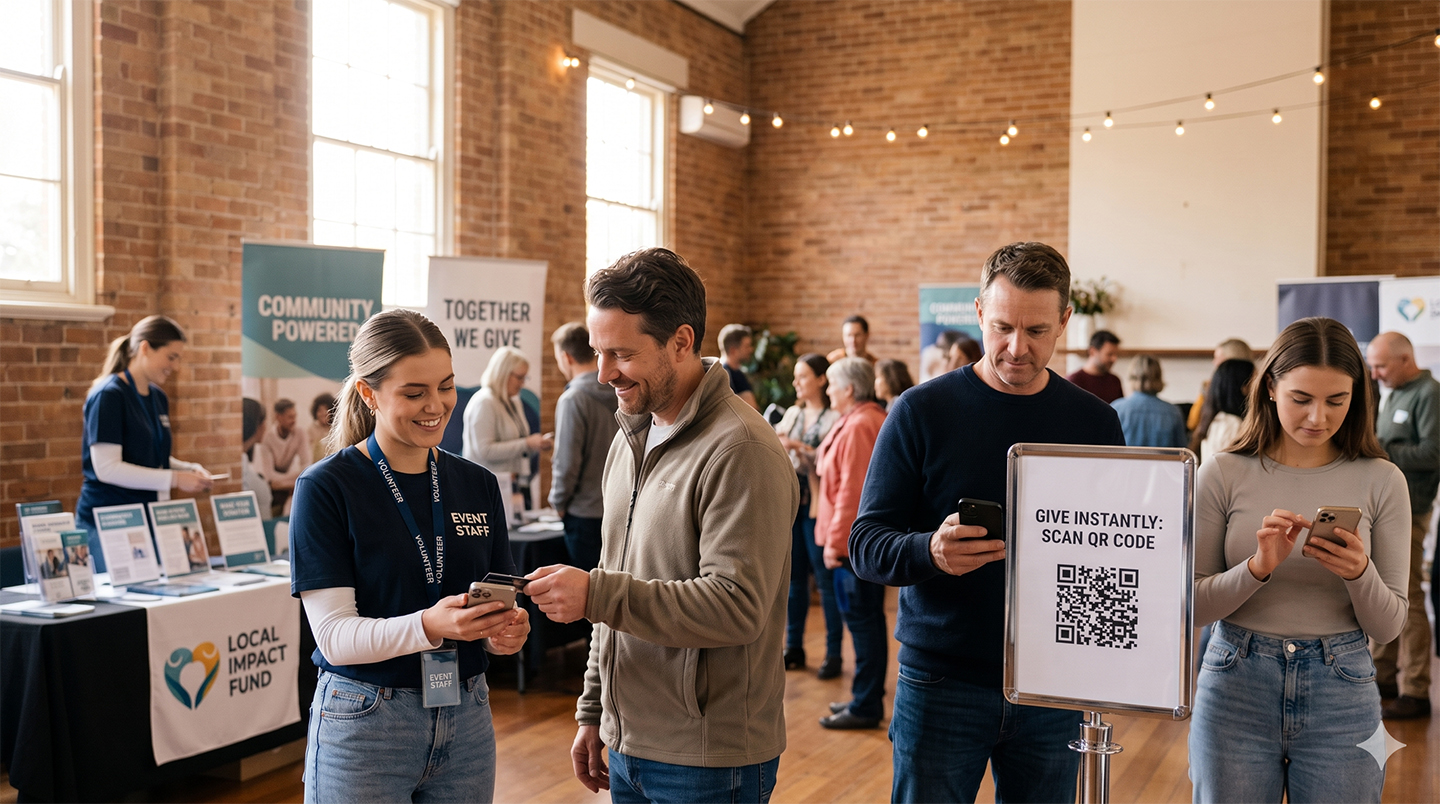
- QR codes let donors give from their own phone at a fixed point, like a poster by the op shop till or a sign at an exhibit.
- Payment links can be sent by SMS or email — useful for following up a lapsed regular giver or invoicing a corporate sponsor.
- PayID moves money bank-to-bank in real time, settling directly into the charity's account.
One accuracy point worth being honest about: QR codes and payment links are still card-based transactions. The donor is paying by card, so card interchange still applies. They're brilliant operational tools — they're just not a way to dodge card fees. Accepting donations without an EFTPOS machine is about convenience and reach, not cost avoidance. The genuine exception is PayID, which runs on the New Payments Platform and settles bank-to-bank with no card interchange fee at all.
What "one system" actually gives a multi-site charity
When payments are infrastructure rather than a drawer full of mismatched terminals, the benefits compound across locations:
- Every volunteer's phone becomes a donation point. There's nothing to ship between the two op shops and the weekend stall — an authorised volunteer simply logs in and starts collecting.
- One view of everything. Donations from the high-street shop, the second branch, the market and the event appeal land in the same dashboard, so the month-end number is always one click away.
- Roles and permissions per site. A shop coordinator sees their location; the head-office team sees all of them. New volunteers are added in minutes without handing over anything sensitive.
- Consistent records. Receipts and transaction records look the same everywhere, which makes acquittals, audits and grant reporting far less painful.
This is where Pebl's background matters. Pebl came into software from payments, not the other way around — so the multi-location, multi-volunteer reality of a real charity is built into the foundation rather than bolted on. That's a meaningful difference from a single-merchant terminal or a generic card reader that was only ever designed for one shopfront.
Fees, surcharges and the October 2026 change
There's a regulatory shift that every multi-site charity should plan for now. From 1 October 2026, the Reserve Bank is removing surcharging on eftpos, Mastercard and Visa. In practice that means you won't be able to add a card fee on top of a donation at the till to recover your processing cost.
For a charity running donations across many locations, two things follow. First, budget for card processing as an absorbed cost of fundraising rather than something passed to the donor. Second, where a donor would genuinely prefer to give the full amount with nothing taken out, PayID is the one method that bypasses card rails entirely — so it's worth offering as an option, especially for larger or recurring gifts, rather than treating it as an afterthought.
Getting started across your locations
You don't need to overhaul everything at once. A sensible path is to pick your two busiest sites, get the coordinators and a couple of volunteers set up on their own phones, and run a fortnight watching the donations from both flow into a single view. Once the reconciliation headache disappears for those two, rolling out to the market stall, the events team and the remaining branches is mostly just adding people.
If your charity collects in more than one place, the goal isn't another device — it's seeing all of it together. You can set up Pebl Collect and add your locations and volunteers at web.peblpay.com.au.