

.svg)
.svg)
For years, the message to Australian charities was simple: cash is dying, so get ready for a cashless future. Many fundraising teams took it to heart, quietly retiring the donation tin and assuming supporters would simply tap or transfer instead. Then the Reserve Bank released its 2025 Consumer Payments Survey — and the data told a more nuanced story.
If your charity is weighing up whether to go fully cashless in 2026, the honest answer is: not so fast. Here's what the latest figures mean for how you collect donations, and why the smartest fundraising teams are building for flexibility rather than betting on a single payment method.
What the RBA's latest data actually found
According to the Reserve Bank's analysis of its 2025 Consumer Payments Survey, cash was used for around 15 per cent of consumer payments in 2025 — up from 13 per cent in 2022. It's the first recorded increase since the RBA began tracking payments in 2007, and cash use held steady across different ages, incomes and locations.
That doesn't mean cash is making a comeback. Card and mobile payments still dominate, and most large charities now receive the bulk of their donations digitally. But it does puncture the idea that cash will vanish on a predictable timeline. From January 2026, the Australian Government also began requiring many grocery stores and petrol stations to accept cash — a signal that physical money will remain part of everyday life for years yet.
For charities, the takeaway is clear. A share of your supporters — often older donors, or people giving spontaneously on the street — still reach for notes and coins. Cut off that channel entirely and you risk leaving donations on the table.
Why "should we go cashless?" is the wrong question
Framing the decision as cash versus cashless misses the point. Donations don't come from a single type of giver. They come from the retiree dropping a fiver in a collection tin, the commuter who only carries a phone, the event attendee who wants to split a donation across a card, and the regular supporter who prefers a direct bank transfer.
The Australian charity sector is enormous and diverse — the ACNC's Australian Charities Report shows donations and bequests make up a far larger share of revenue for small charities than for large ones. If you run a smaller organisation that depends heavily on community giving, every missed donation matters more. The right question isn't "cash or cashless?" It's "can we accept a donation from anyone, anywhere, the moment they want to give?"
Answering yes means thinking less about individual payment methods and more about the infrastructure underneath them.
The donation channels worth setting up in 2026
A resilient charity collects through several channels at once. Here's how the main options stack up — and one important distinction on cost that's easy to get wrong.
- Cash — still relevant, still spontaneous, and the only channel with no transaction fee. The trade-off is handling: counting, banking and reconciling cash takes volunteer time and carries security risk.
- Tap to Pay on a phone — lets any volunteer accept contactless cards, Apple Pay and Google Pay on their own smartphone, with no separate terminal to buy or hand out. It's the natural replacement for the donation tin at events and on the street. We've written before about how Tap to Pay is changing donations for Australian non-profits.
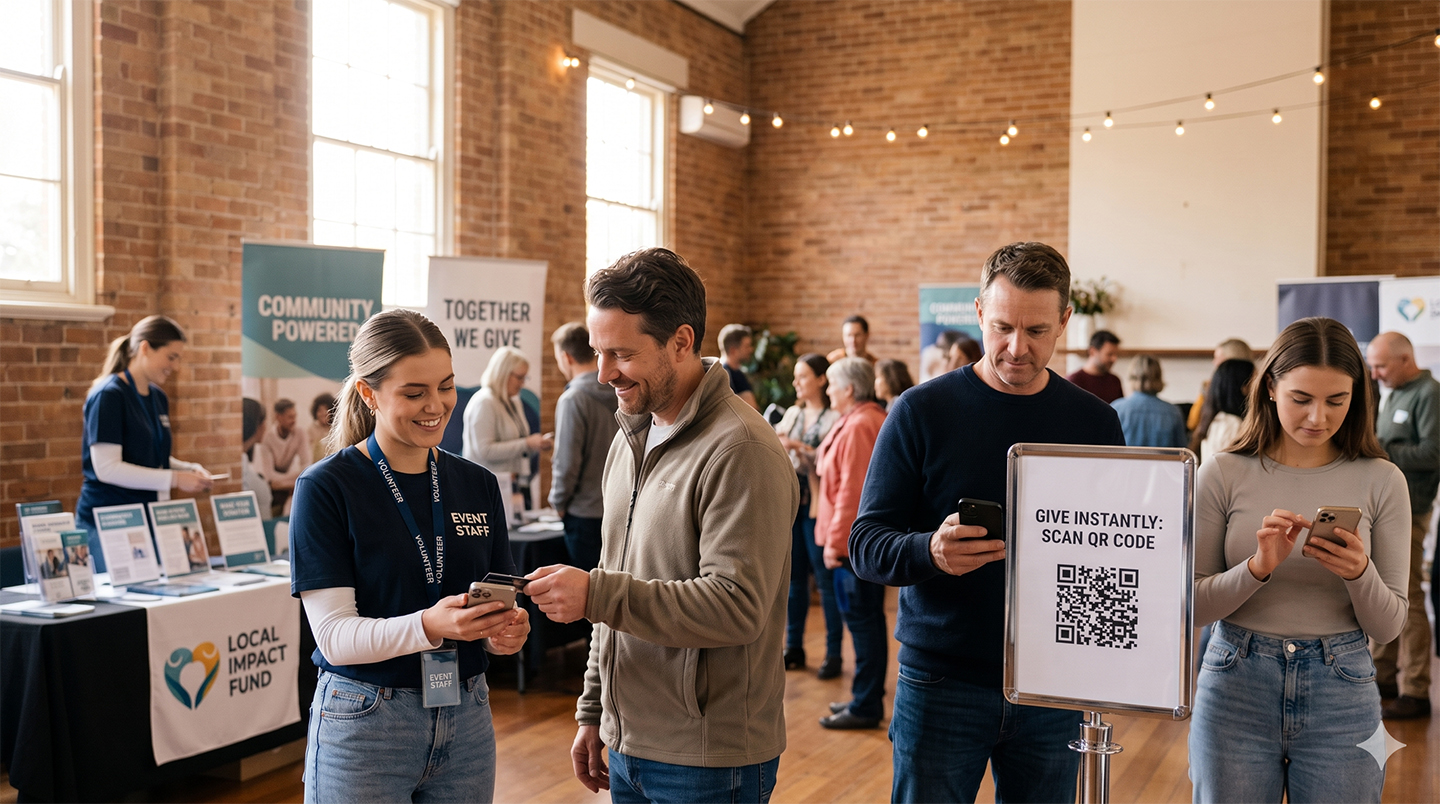
- QR codes and payment links — brilliant operational tools for unattended giving: print a QR on signage, or text a payment link to a supporter who pledged at an event. Worth being clear, though, that these are card-based transactions. Interchange and card fees still apply, so treat them as a way to capture more donations and reach more donors — not as a way to dodge card costs.
- PayID — the one method that genuinely bypasses the card networks. Built on Australia's New Payments Platform, PayID moves money bank-to-bank in real time and carries no card interchange fee, which makes it especially efficient for larger or recurring gifts where card fees would otherwise eat into the donation.
Notice that no single channel wins on every measure. Cash costs nothing to process but plenty to handle. Card-based tools are frictionless for donors but carry interchange. PayID avoids card fees but suits considered gifts more than a quick street tap. The strongest setup uses all of them.
It's the infrastructure, not the feature
This is where a lot of charities get stuck. They adopt one tool — a card reader here, a donation page there — and end up with payment methods scattered across systems that don't talk to each other. Reconciling it all at the end of a campaign becomes a nightmare, and nobody can see in real time how much has actually been raised.
The shift that matters is treating payments as infrastructure rather than a collection of disconnected features. Pebl came to software from a payments background, which is why Pebl Collect ties Tap to Pay, Cash, QR codes, payment links and PayID into one platform — so a charity running collections across multiple teams and locations gets every donation, from every channel, in one clean view. Volunteers use their own phones with no hardware to distribute, and you can see funds and supporter details in real time. If you've never set this up before, here's a plain-English look at turning a phone into a payment terminal.
A practical setup for the year ahead
You don't need to overhaul everything at once. A sensible 2026 baseline looks like this:
- Keep accepting cash where it still flows — collection tins, in-person events, older donor bases — but reduce the handling and reconciliation burden by pairing it with digital options (like Pebl Collect).
- Equip every volunteer with Tap to Pay on their own phone so no contactless donation is ever turned away.
- Use QR codes and payment links for unattended and follow-up giving, knowing they're card-based.
- Offer PayID for supporters making larger or recurring gifts where avoiding card fees makes a real difference.
- Make sure all of it reports into one place, so you always know what you've raised and who gave.
Cash hasn't disappeared, and pretending otherwise costs donations. The charities raising the most in 2026 won't be the ones that picked the "right" payment method — they'll be the ones ready to accept a gift in whatever form it arrives.
Want to bring cash, card, QR, payment links and PayID into a single donation setup your whole team can use? Get started with Pebl and give your supporters every way to give.