.svg)
.svg)
Card surcharging in Australia ends on 1 October 2026 — now just days away — and charities are not exempt. From that date every card fee on a donation comes out of the gift instead of the donor's pocket — unless you accept donations by a method that avoids card fees altogether. PayID is that method. It settles bank-to-bank on rails that sit entirely outside Visa, Mastercard and eftpos, so 100% of every gift reaches your cause. Here's how PayID works, how it compares to QR codes and card taps, and exactly how much your charity stands to keep.
The card fee your charity can no longer pass on
Every time a donor taps a card at your collection point or gives online by Visa, eftpos or Mastercard, a merchant fee of roughly 1% to 1.5% is skimmed off the top. Until now, many charities quietly recovered that cost by adding a surcharge. From 1 October 2026 that option disappears: the Reserve Bank of Australia is removing surcharging on eftpos, Mastercard and Visa payments, and the RBA has confirmed not-for-profits are not exempt unless an individual card network's own rules carve one out.
The same reforms are also intended to lower merchants' card costs through changes to interchange fees — but a lower card fee is not the same as no card fee. Even after October, every card donation still carries a cost that your organisation now absorbs rather than passes on. On a $100 donation that is around $1 to $2, gone before it reaches your programs. Multiply it across thousands of gifts a year and it becomes real money. It matters more than ever in a sector under pressure: the ACNC's Australian Charities Report put total donations and bequests at $14.8 billion, yet the share of Australians who give has slid for years. Being able to tell supporters that 100% of their gift reaches your cause is a genuine advantage.
What actually makes PayID different
PayID is Australia's account-to-account payment method, built on the New Payments Platform (NPP) — real-time payment rails that sit entirely outside the card networks. When a donor gives via PayID, they make a bank-to-bank transfer straight from their account to yours. No Visa, no Mastercard, no eftpos, and therefore no interchange fee.
This is not a fringe method. More than 25 million PayIDs are now registered, and the NPP clears over 155 million real-time payments a month — around $7 billion every day. In 2025 it processed 1.9 billion transactions worth $1.7 trillion, up 12.2% year on year. For a charity, that reach translates into four concrete advantages:
- No card fees taken from the gift — 100% of the donation lands in your account.
- Instant settlement — funds arrive in real time, not after an overnight batch or a multi-day clearing delay.
- Donor confidence — the donor sees your organisation's verified name before they confirm the payment.
- No terminal required — donors pay from their existing banking app using your PayID, which can be a phone number, email address or ABN.
PayID vs QR codes and payment links: what actually avoids the fee
This is where a lot of charities get caught out. QR codes and payment links feel modern and frictionless, but when a donor scans a code or taps a link and pays by Visa or Mastercard, it is still a card transaction — and the card fee still applies. Here is the distinction that matters after 1 October:
- PayID — bank-to-bank on the NPP. No card rails, no interchange, 100% of the gift retained.
- QR codes and payment links — excellent operational tools for accessibility, online campaigns and social giving, but the payment behind them is card-based, so the card fee still applies.
- Tap to Pay on a phone — the best way to capture spontaneous in-person giving, but again a card transaction with a card fee.
In other words, QR codes and links solve how a donor gives; PayID solves what it costs you. If you want the difference spelled out in full, our guide to account-to-account and contactless payments with Pebl breaks it down.
How much your charity could keep
Consider a charity raising $200,000 a year in card-based donations. At an average card fee of 1.5%, that's $3,000 a year going to payment infrastructure instead of programs. If just 30% of those donors switched to PayID, roughly $900 a year would flow straight back into your work — with no change to the donation amount and barely any change to donor behaviour. For organisations processing millions in annual donations, the saving compounds into tens of thousands of dollars — money that, from October, you can no longer recover through a surcharge.
The smart setup: offer every method, steer the fee-conscious to PayID
The best-run charities don't pick one payment method — they offer all of them and are deliberate about when each is used. For a full comparison of every option and its trade-offs, see our breakdown of cashless fundraising for Australian charities, and if you're weighing whether to go fully cashless at all, what the RBA's data means for fundraising is a useful reality check.
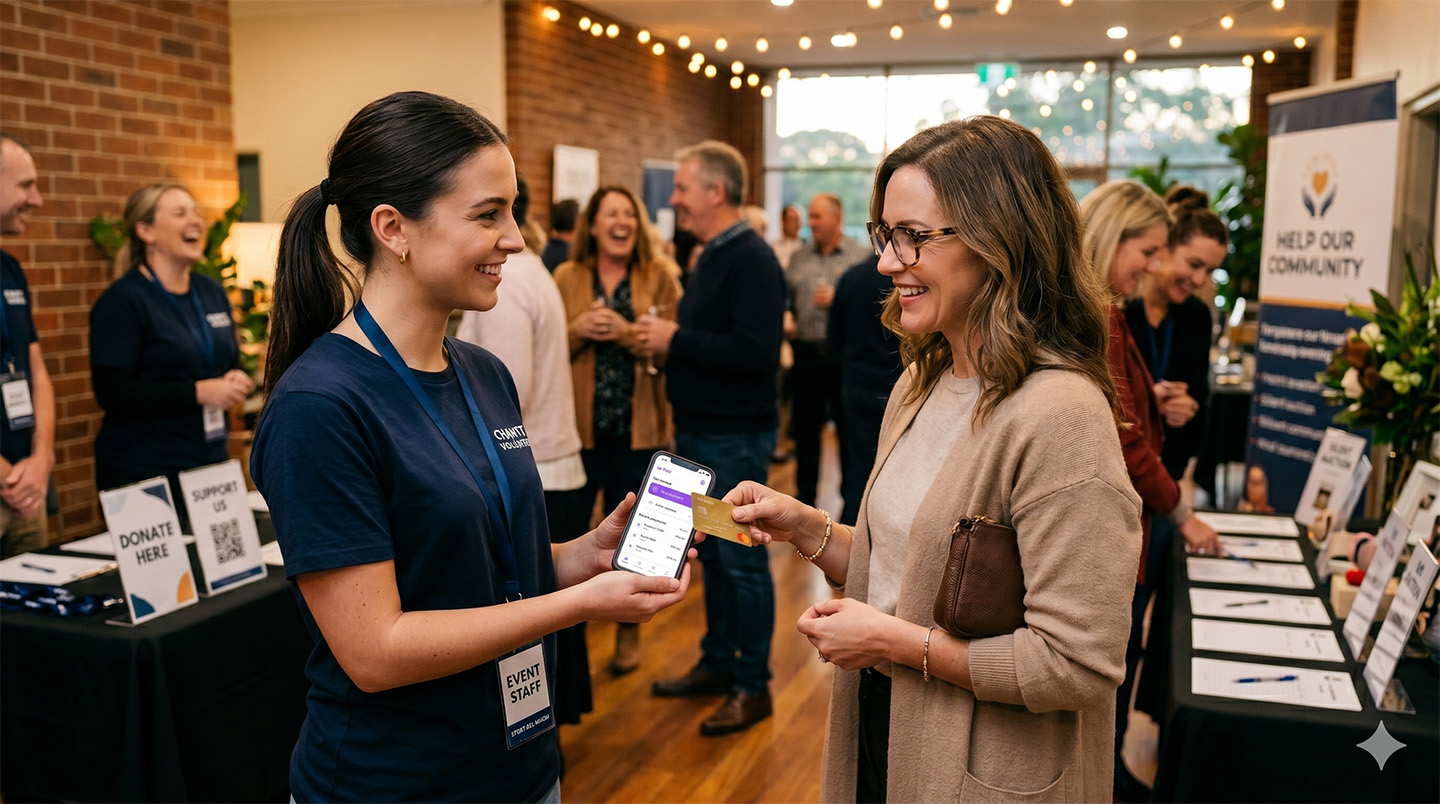
- In-person events: Tap to Pay on a phone captures spontaneous giving moments that would otherwise be lost — our guide to accepting donations at events without an EFTPOS machine shows how, and for fundraising nights specifically there's a gala, auction and trivia-night playbook. Card fees apply, but the frictionless experience is worth it — and you can steer larger auction wins to PayID.
- Online, email and social campaigns: Payment links and QR codes let a supporter give in under 30 seconds from wherever they see your message.
- Regular givers, major donors and fee-conscious supporters: PayID is the optimal method. Feature it on receipts, share it with recurring donors, and put it front and centre on your website.
If your charity runs op shops, branches or multiple events, keeping every method and every site reconciling back to one view matters just as much as the fee — our guide to running donations across op shops, branches and events covers how. And choosing the right hardware and app for the in-person side is its own decision — our roundup of the best POS systems for charities and nonprofit events in 2026 covers what to look for.
How to start accepting PayID donations
The transition doesn't require new hardware or a complex integration. If your charity already banks with a PayID-enabled institution — most do — you can begin accepting PayID donations today. Pebl Collect brings Tap to Pay, QR codes, payment links and PayID together in one platform built specifically for Australian charities and nonprofits, so your team can run giving across multiple events, locations and campaigns from a single account — with real-time visibility into how much came in through each channel, and no expensive terminals or long-term contracts.
With the surcharge ban now just days away, the charities that come out ahead will be the ones offering donors every payment option while quietly steering fee-sensitive giving toward PayID. Ready to keep more of every dollar? Get started with Pebl Collect — mobile payment infrastructure built for Australian charities.